JUST UPDATED January 2026: New PMI CP & PMI RMP Simulators, try Free PMI CP y PMI RMP Exams
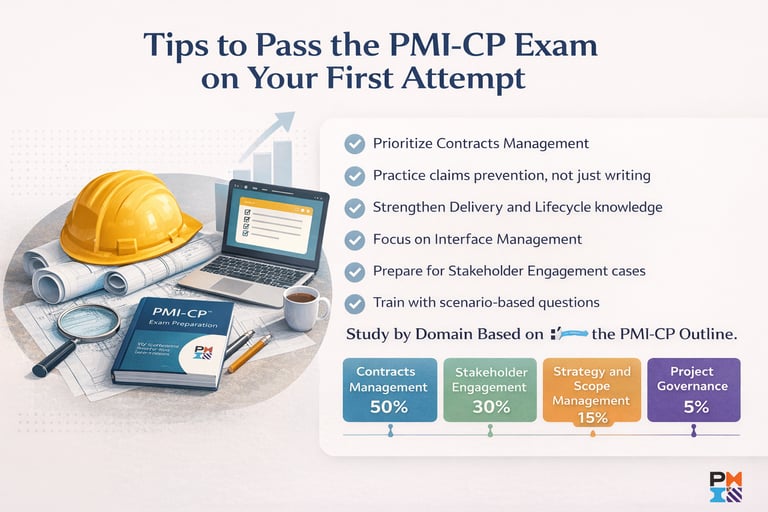
A practical way to prepare is to align your study plan directly with the PMI-CP Examination Content Outline. The exam is weighted by domain, with Contracts Management representing the largest portion (50%), followed by Stakeholder Engagement (30%), Strategy and Scope Management (15%), and Project Governance (5%). With that in mind, I recommend the following approach.
First, prioritize Contracts Management. Concentrate on risk and claims because they are explicitly emphasized in the outline. In particular, ensure you can manage the risk process through Front-End Planning, classify risks appropriately, and prioritize them early. Also, practice applying risk tools, especially IPRA, and be comfortable with risk registers and probabilistic techniques at a conceptual level (when to use them and how to interpret outputs for decisions).
Second, train yourself to think “claims prevention and early resolution” rather than “claims writing.” The outline emphasizes understanding the difference between change/variation orders and claims, using documentation and communication as best practices, and using intervention points to resolve issues early. In practice, this means you should consistently ask, in every scenario: What is the contractual trigger, what is the notice requirement, what contemporaneous records prove the facts, and what is the fastest defensible path to resolution.
Third, strengthen your capability in contract lifecycle and delivery methods. You should be ready to advise (in scenario form) which delivery method and contract structure fit a given context and how that choice affects risk allocation, roles, responsibilities, and potential communication gaps.
Fourth, do not neglect Interface Management. Mega-project scenarios often hinge on poorly managed interfaces, unclear boundaries, and coordination breakdowns. The outline explicitly includes planning interface points, classifying interfaces, and applying effective interface management practices through the life cycle.
Fifth, for Stakeholder Engagement (30%), prepare for scenario questions where the “best answer” is the one that prevents communication failure: selecting an appropriate communication approach, tailoring messages, establishing feedback loops, and maintaining stakeholder buy-in.
In terms of method, I suggest you prepare with a strong scenario-based routine:
Read the scenario and identify the domain it belongs to.
Extract the key constraint (time, cost, safety, operational continuity, stakeholder alignment).
Select the response that is contractually sound, evidence-based, and proactive (prevention first).
After every practice set, review the questions you missed and write a one-line lesson learned (what signal you missed and what principle should have guided you).
Finally, keep in mind that the PMI-CP outline reflects real job tasks and is not limited to the PMBOK Guide; you should therefore focus on applied decision-making in construction and built environment contexts.